Benign vs Malignant Tumors: What’s the Difference?
Learn the difference between benign and malignant tumors, including growth, spread, symptoms, diagnosis, treatment, and why accurate diagnosis matters.

Learn the difference between benign and malignant tumors, including growth, spread, symptoms, diagnosis, treatment, and why accurate diagnosis matters.
Written by Chandan Kumar | Published on Sept. 3, 2026
Hearing the word “tumor” can naturally cause concern. However, not every tumor is cancerous. Tumors can generally be classified as benign or malignant, and understanding the difference is an important part of cancer awareness.
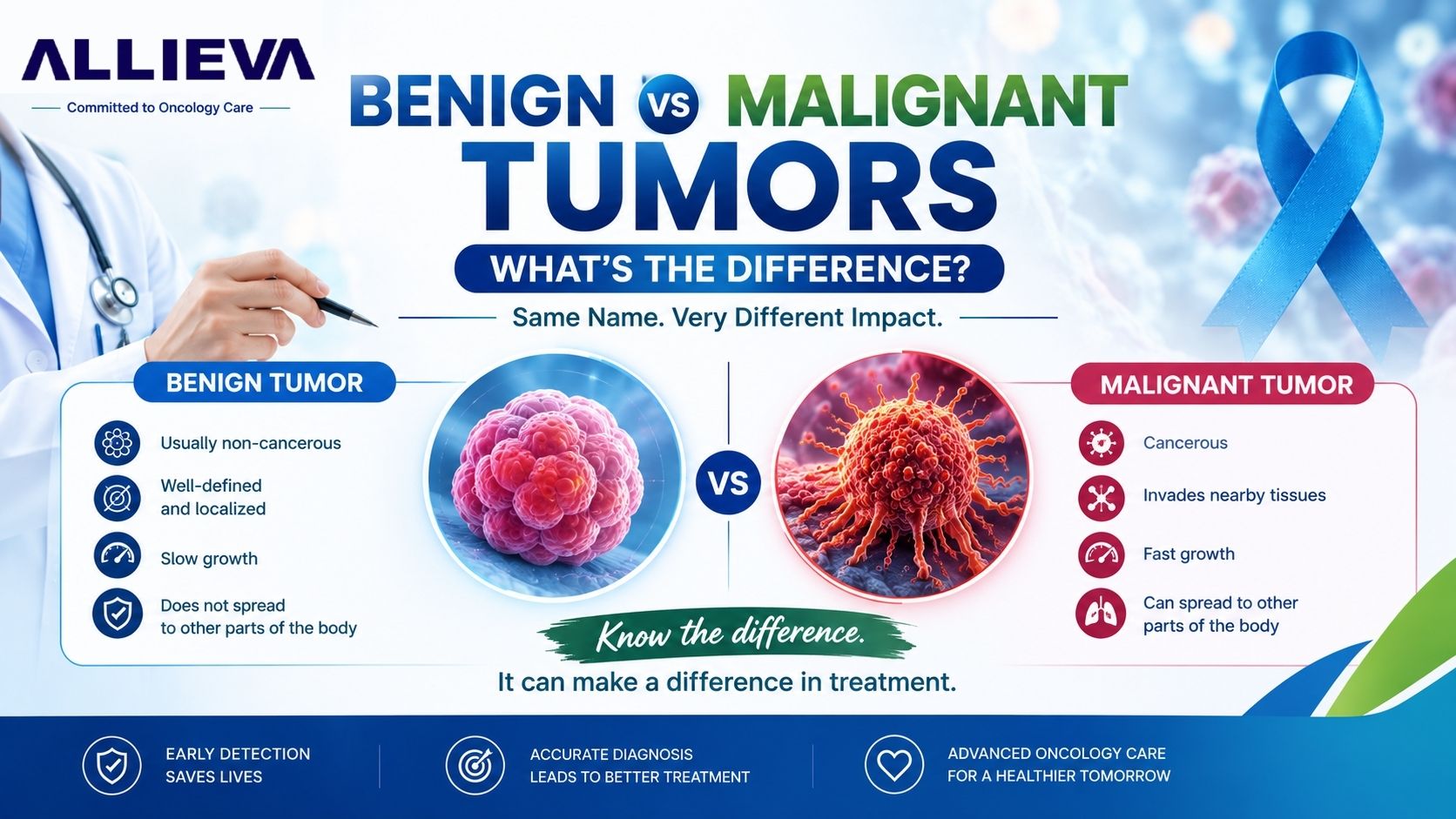
A benign tumor is generally non-cancerous and remains localized, while a malignant tumor is cancerous and can invade nearby tissues or spread to other parts of the body.
But the distinction is more detailed than simply calling one “good” and the other “bad.” The location, size, growth pattern, cellular characteristics, and overall behavior of a tumor all matter when doctors determine the appropriate approach.
In this article, we explain the difference between benign and malignant tumors, how doctors diagnose them, what symptoms they may cause, and how they are treated.
A tumor is an abnormal mass of cells that develops when cells grow or divide more than they normally should, or when they fail to die when they should.
Tumors can be:
Not all cancers form solid tumors. For example, leukemia affects blood-forming tissues and typically does not produce a solid mass in the same way as many other cancers.
A benign tumor is a non-cancerous growth.
Benign tumors generally:
However, benign does not always mean harmless.
A benign tumor can cause problems if it becomes large or develops in a sensitive location. For example, a benign growth in the brain can put pressure on surrounding structures and cause significant symptoms.
Some benign tumors may require monitoring, medication, or surgical removal depending on their size, location, symptoms, and type.
A malignant tumor is cancerous.
Malignant cells can grow abnormally and may invade surrounding tissues. Some malignant cancers can also enter the blood or lymphatic system and spread to distant parts of the body.
This spread is called metastasis.
Malignant tumors may vary considerably in how quickly they grow and how aggressively they behave. Therefore, doctors consider several characteristics when evaluating them.
| Feature | Benign Tumor | Malignant Tumor |
|---|---|---|
| Cancerous? | Generally no | Yes |
| Local invasion | Usually does not invade surrounding tissue | Can invade nearby tissues |
| Metastasis | Does not metastasize | Can metastasize |
| Growth | Often slower | Can be faster, but varies |
| Cell appearance | Often more similar to normal cells | May look significantly abnormal |
| Treatment | May only require monitoring or removal | Often requires active cancer treatment |
| Recurrence | Usually less likely after complete removal | Can recur depending on cancer type and treatment |
These are general characteristics. Individual tumors can behave differently, so diagnosis by a healthcare professional is essential.
Both benign and malignant tumors can develop when normal controls over cell growth and division become disrupted.
Cells normally receive signals telling them when to:
Genetic changes can interfere with these processes.
In some cases, abnormal cells continue to multiply and form a mass.
If the cells remain localized and do not demonstrate cancerous behavior, the growth may be classified as benign.
If the cells acquire characteristics that allow them to invade surrounding tissues or spread to distant locations, the tumor may be malignant.
This depends on the specific type of tumor.
Most benign tumors do not become cancerous. However, certain abnormal or precancerous conditions can have the potential to develop into cancer.
This is why doctors sometimes recommend monitoring or removing particular growths, even when they are not currently malignant.
The risk depends on the specific type, location, cellular characteristics, and other individual factors.
Symptoms depend heavily on where a tumor develops.
Some tumors cause no symptoms and are discovered during an examination or imaging test performed for another reason.
Possible symptoms may include:
These symptoms do not automatically indicate cancer.
Many common medical conditions can cause similar symptoms. Persistent or unexplained changes should be evaluated by a healthcare professional.
Doctors may use several methods to determine the nature of a tumor.
A doctor may examine a lump or swelling and ask about symptoms, medical history, and family history.
Imaging can help doctors understand the size, location, and characteristics of a growth.
Common imaging methods include:
A biopsy involves removing a sample of cells or tissue for examination.
A pathologist examines the sample under a microscope and may perform additional tests to determine whether the cells are benign, malignant, or show other abnormal characteristics.
For many suspected cancers, biopsy and pathology are central to establishing the diagnosis.
The treatment approach for a benign tumor can be very different from that for a malignant tumor.
Accurate diagnosis helps doctors determine:
Doctors may also evaluate the stage and grade of a malignant tumor.
Staging helps describe the extent of cancer, while grading provides information about how abnormal the cancer cells look and, for some cancers, how aggressively they may behave.
Not every benign tumor requires immediate treatment.
Depending on the circumstances, doctors may recommend:
Some small, asymptomatic benign tumors may simply be monitored with regular examinations or imaging.
Certain benign conditions may respond to medicines depending on their cause and type.
Surgical removal may be considered if a benign tumor:
The decision is individualized for each patient.
Cancer treatment depends on the type, location, stage, grade, molecular characteristics, and overall health of the patient.
Treatment may involve one or more approaches.
Surgery can remove a localized cancer when appropriate.
Chemotherapy uses anti-cancer medicines to destroy or control cancer cells.
Radiation uses high-energy radiation to damage cancer cells.
Targeted medicines act on specific molecules or biological pathways involved in cancer growth.
Immunotherapy helps the immune system recognize and attack cancer cells.
Certain cancers use hormones to grow. Hormone therapy can block or reduce the effects of those hormones.
A multidisciplinary oncology team may combine several treatments to develop an individualized plan.
Modern oncology medicines have expanded treatment options for patients with different types and stages of cancer.
At Allieva Pharma Pvt. Ltd., our pharmaceutical portfolio includes products supporting different areas of oncology care.
Some products in the Allieva Pharma oncology portfolio include:
Paclitaxel is an antineoplastic medicine used for the treatment of several cancers, including certain breast, ovarian, and lung cancers, depending on the approved indication and treatment protocol.
Regorafenib is a multikinase inhibitor used for specific advanced cancers, including certain colorectal cancers, gastrointestinal stromal tumors, and hepatocellular carcinoma, according to approved indications.
Enzalutamide is an androgen receptor inhibitor used in the treatment of certain forms of advanced prostate cancer.
Carfilzomib is a proteasome inhibitor used as part of treatment regimens for multiple myeloma.
The selection of an oncology medicine depends on the individual patient's diagnosis, disease characteristics, previous treatments, and the treating physician's clinical judgment.
One common misconception is that benign tumors can always be ignored.
That is not necessarily true.
A benign tumor can cause significant problems when it:
For this reason, even a confirmed benign tumor should be managed according to medical advice.
Cancer is not one single disease.
There are hundreds of cancer types, and they can behave very differently.
Some cancers grow relatively slowly, while others can progress rapidly. Some respond very well to treatment, while others may require long-term management.
Doctors therefore consider the specific cancer type and its biological characteristics rather than relying only on the word “malignant.”
Early diagnosis can be important for many cancers.
When cancer is detected before it has spread extensively, treatment may be more effective and additional treatment options may be available.
Early detection can involve:
People should follow screening recommendations appropriate to their age and individual risk factors.
Consider consulting a healthcare professional if you notice:
These symptoms can have many causes and do not necessarily indicate a tumor or cancer.
However, getting an appropriate medical evaluation is better than trying to diagnose the cause yourself.
No. A benign tumor is generally non-cancerous and does not metastasize. However, some benign tumors can cause serious problems depending on their location or size.
Yes. A malignant tumor is cancerous and has the potential to invade surrounding tissues and, in many cases, spread to distant parts of the body.
Benign tumors generally do not spread to distant parts of the body through metastasis.
Malignant tumors are generally more serious because they can invade nearby tissues and potentially spread to distant organs. However, the seriousness of any tumor also depends on its location, size, type, and effects on the body.
Doctors may use physical examination, imaging, and biopsy. Pathology examination of tissue is often crucial in determining the nature of a tumor.
Yes. Depending on the tumor's type, size, location, and symptoms, doctors may recommend surgical removal.
No. Some benign tumors may only require observation, while malignant tumors generally require active treatment. The appropriate approach depends on the individual diagnosis.
Understanding the difference between benign and malignant tumors can help reduce confusion when discussing a new growth or tumor diagnosis.
Benign tumors are generally non-cancerous and remain localized, while malignant tumors are cancerous and can invade nearby tissues and potentially spread to distant parts of the body.
However, the behavior of tumors can vary considerably. A benign tumor may still cause serious problems because of its location or size, while many malignant cancers can be successfully treated or controlled with modern medical care.
Accurate diagnosis is therefore essential. Imaging, biopsy, pathology, staging, and other diagnostic assessments help healthcare professionals understand the disease and select an appropriate treatment strategy.
At Allieva Pharma Pvt. Ltd., we remain committed to supporting oncology care through quality pharmaceutical products and a growing focus on cancer treatment and healthcare needs.
If you notice a new, persistent, or unexplained lump or other unusual change in your body, consult a qualified healthcare professional for proper evaluation.
This article is provided for general educational and cancer-awareness purposes only. It should not be considered a substitute for professional medical advice, diagnosis, or treatment. The information presented here does not establish a diagnosis. Always consult a qualified healthcare professional regarding symptoms, tumors, cancer diagnosis, or treatment decisions.
Explore more pharma blogs and news from Allieva Pharma.